
Finding a Way In
Have you ever felt as if your would-be essay or book was a tightly locked house, with you outside banging on the doors and windows trying to find a way in? If so, I have some strategies to help.

This is It Takes A Village, a monthly conversation about reading, writing, and community-building.
Welcome, lovely subscribers, lurkers, readers, and writers! So happy to have you here! A special welcome to new subscribers—we’re so glad you’ve joined our village.
In this issue:
On the Farm
Writer’s Life
An Apology and the Book of the Month
Bonus: Writing Prompt
On The Farm
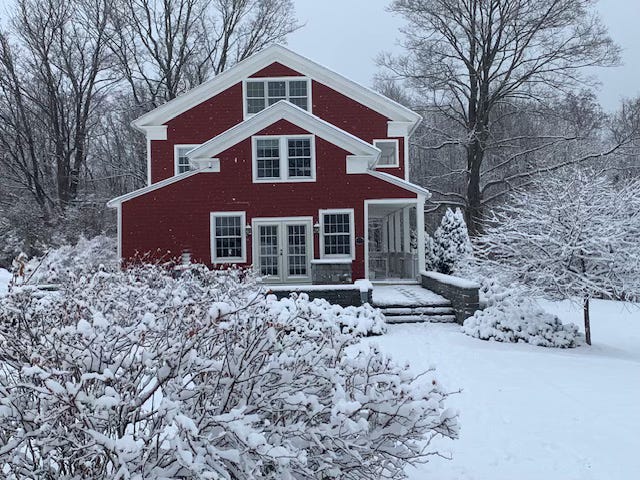
Our two-hundred-year-old farmhouse is generally not the kind of dwelling I described in the opening of this newsletter. That is to say, it’s not exactly tightly sealed. More like drafty and prone to visitors finding their way in, from mice and bats to box elder bugs and our dear neighbor who shows up unannounced on summer evenings with his arms full of produce from his garden. Last summer, a bat entered through a hole in the attic that had been handily crafted by a woodpecker. The bat flapped me awake from sleep—always bad news, as I learned from the county health department, because a bat’s sharp, tiny teeth can bite you in your sleep and you’d never know it. My husband and I underwent a series of rabies shots—not a big deal these days, and kindly paid for by the county health department, but all in all, we could have done without that particular home invasion.
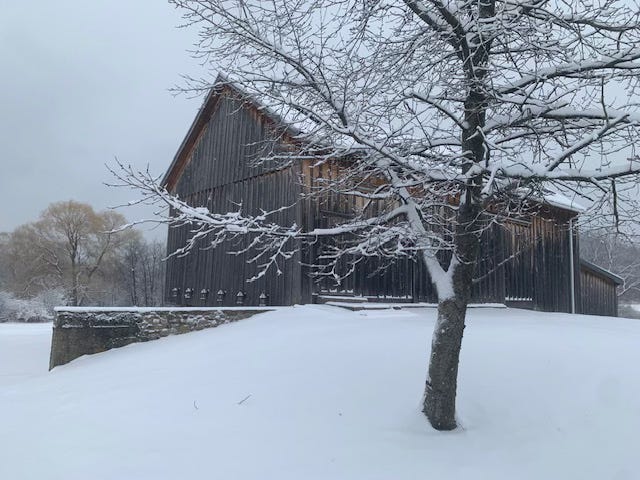
The barn, on the other hand, has a problem in winter that can make entry (and exit) nearly impossible, at least for humans. I refer here to the lower barn. Our barn is even older than the house, built by the first white man to own the land after the state of New York took it from the native Haudenosaunee. It’s large enough to have an upper floor where my husband works in his shop and where we store things, and a lower floor that, at one time, housed cows, horses, and pigs—there’s still a slurry culvert in the floor. This lower floor now has no animals, unless you count the myriad birds, snakes, squirrels, mink, possums, groundhogs, and the occasional visiting barn cat. Instead, it holds trash and recycling bins, boats, and heavy equipment like the tractor we use in winter to clear snow from the driveway. Unfortunately, the huge sliding barn doors collect moisture, then swell and expand when temperatures plummet, at which point they become immovable. No tractor gets out to clear the snow, and trash has to be hauled twice as far out the opposite side of the barn and down the long driveway.
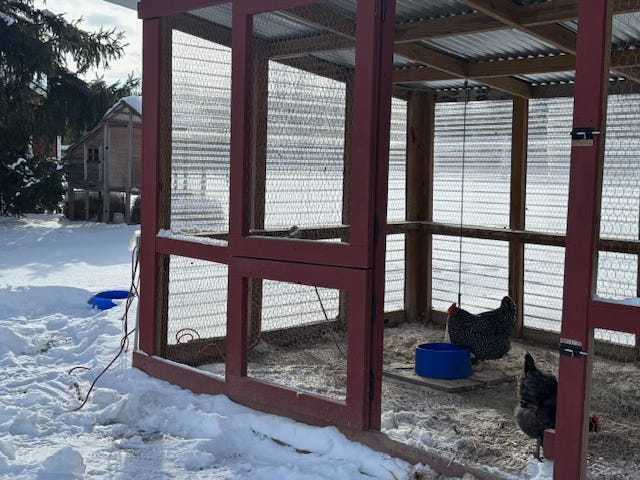
And the poor chickens! This year, the snow is so high, I had to shovel a path around the chicken run so the chickens could get into their yard. (Not that they want to run around much in subzero weather, but I thought I should offer them the option.) Brave Laverne, our one Leghorn, was the only chicken to make use of the shoveled path.
Writer’s Life
Since it’s that time of year when the cold wind rattles the windows and we’re trying to remember to leave the barn door open so we’ll be able to get in when it freezes, and I’m shoveling access paths for fowl, and also because I’ve been at my desk ruminating on the entry point to a particular essay, I’m a little obsessed with how we find a path into things.
How often have you had an idea for a piece of writing, but couldn’t find the right way to begin or the appropriate container to hold what you have to say? This happens to me frequently: I have the topic, and I can feel the story I want to tell, but there’s no clear way in. I can hang out that way for months, with the story idea dangling at the edge of my consciousness. Usually, what happens is I’ll be doing something completely different, like walking the dogs or eating lunch, and the first line will come to me, as if spoken in my ear. After that first line, I’m off, and the essay pours out. When it’s a matter of the appropriate container, it’s more complicated but generally involves coming upon something seemingly unrelated to the story, such as an image, that becomes a kind of bookend or an opportunity to braid, or a way of introducing a character. These solutions require quiet downtime during which the mind wanders, becoming increasingly flexible and associative.
Unfortunately, most of us don’t have much downtime. Often, we’re on a deadline. Forcing this sort of process can feel like the exact opposite of what’s needed. However, there are habits you can adopt to relax the brain into receptivity and flexibility, habits that, when practiced regularly, make it more likely you’ll find a way into your writing when you need it. Here are some strategies that work for me.
Read. Read widely and daily, and include poetry. Poetry, in particular, will strengthen your ear so that you can hear your entry point when it arrives; it will make you more attuned to image and to the unexpected, to placing disparate words and ideas side by side and seeing them interact with one another. Also, read slowly so that you can hear the music of the language in your head as you read.
Watch artsy movies. Watch movies that have won awards—strange movies, foreign films, films you don’t think you’ll like. Pay attention to the cinematography, color, images, angles. How would you recreate in words the feeling these film elements give you? Study body language, pacing, what or who gets a close-up shot and why.
Keep a journal just for goodies. Write lines you love from your reading or your imagining and riff on them. List words or pairs of words that don’t necessarily go together. I recently had success using a word pairing from my journal: “paper room.” The concept became central to an essay I was writing. Jot down images you come across and questions you’d like to be able to answer. When you’re stuck, go back to the journal and see if one of your entries is the door to your piece.
Stare into space. I know, I know, you don’t have time for this. But you eat lunch, right? Stare out the window as you chew. Let your mind wander. Even a moment can present you with the answer you seek.
Be aware that it may not be the first line you’re looking for. While the first line is the entry point for the reader, it’s not necessarily the entry point for the writer. I have a friend who “hears” the last line of her essays. I envy her—she always knows where she’s headed.
Get good sleep. By good sleep, I mean regularly timed and long, so that you’re likely to achieve at least an hour of REM sleep. Dreaming is not only healthy for your brain, the images and associations in dreams can ignite your writing.
Steal the first line of another writer’s work. Rework it, but keep the structure. Make it speak to the idea you’re working on. Similarly, take a piece you’ve read that you love, and analyze what makes it work. What are the moving parts, and can you build a similar “machine” for your own piece?
If you’re enjoying my Substack and you’re in need of a writing coach or editor, you may want to work with me. I have spaces open for this spring. You can find out more by clicking this link:
Book of the Month
I have an apology to make. I screwed up when I recommended in my October newsletter that you read Best American Essays 2025. I had not read it, which I stated at the time, but the series has been so reliably excellent, I felt sure I could recommend with confidence the 2025 anthology due to come out that month. Well, I finally got around to reading it, and boy, was I wrong. It’s mostly comprised of dry, academic essays that failed to move me. Only one essay appealed to me, the lovely “Gone for a Spell,” by Angie Romines. (you may be able to access it on the Kenyon Review website—you may need to pay for a subscription, but c’mon, it’s the Kenyon Review and so worth it.)
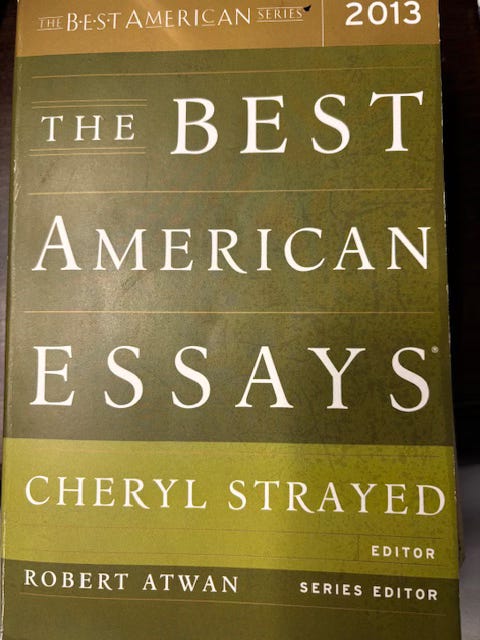
After I discovered my blunder, I got to thinking that there’ve been a few Best American Essay anthologies over the years that I never read, so I went straight to Thrift Books online and ordered some of them. My favorite so far is 2013, edited by Cheryl Strayed. In the Introduction, Strayed writes, “When I teach writing I tell my students that the invisible, unwritten last line of every essay should be “and nothing was ever the same again.” I’ve never taken a class with Strayed, so I don’t know what kind of teacher she is, but this seems like excellent advice. I’ve known for a long time that she’s a wonderful writer. Now I know she’s a hell of an editor who knows a great essay when she sees one. Each of the essays in this volume meets her criteria, and another as well: at the end of each essay, we, the readers, are never the same again. These are stories so mesmerizing, so beautifully told, they enter you, and then they stay. Take, for example, the very first essay, “Free Rent at the Totalitarian Hotel” by Poe Ballantine, first published in The Sun. The essay, just sixteen pages, is peopled by the most exquisitely drawn characters, each of whom could be the subject of their own book—and we kind of wish they were. There’s a lot going on here with the struggles and inner life of the speaker, the jobs and love lives of the various characters, and even the precipitous fall of the stock market. But, like a juggler whose flying objects all end up in his hands as he takes a final bow, Ballantine brings them all together in a satisfying final paragraph that’s brilliant and self-deprecating, and gives us the thrill of Strayed’s and nothing was ever the same again. I wanted to rise to my feet and shout Bravo!
These are the sorts of essays I like to study for their characters, structure, timing, language—every moving part that adds up to excellence. This particular volume makes a marvelous classroom.
Bonus: Writing Prompt
This month, let’s try using the first lines of other writers’ essays to massage and riff on, making something uniquely our own. Here are some juicy first lines from Best American Essays 2013:
“When I was young, there seemed to be never a childbirth, or a burst appendix, or any other drastic physical event that did not occur simultaneously with a snowstorm.” (Alice Munro) This entry point of “When I was young” can conjure memories and sets up an immediate container for building an essay around the idea of change.
“At school today an esteemed member of my department said his grandfather, at age eighteen, ‘ran off’ to join a circus.” (Richard Schmitt) This entry point of an offhand comment by some peripheral person, and a phrase that can be picked apart for meaning, “ran off,” presents delicious possibilities.
“In the summer of 1985, somewhere near Martinsburg, Pennsylvania, the body of a young woman was pulled from a truck-stop dumpster.” (Vanessa Veselka) Immediately, we have the time period, the setting, and a gruesome crime.
“On Thanksgiving my father asked me if I wanted to visit the Nazi.” (Matthew Vollmer) I love the juxtaposition of the ordinary (Thanksgiving) with the say what! (Nazi).
“In what I hoped would be our final appointment with the midwife, she guessed you weigh eight pounds and four ounces and that you will come soon.” (Marcia Aldrich) The direct address to the unborn child carries rich possibilities. What else or who else could you address?
Select one of these first lines to emulate. Retain its cadence, structure, tense, and address, but write it from and about your own life or something you know. Use it as your door into a new essay. Once you have the first line, set a timer for twenty minutes and write the next few paragraphs. Keep going even if you feel stuck. Use the act of writing not as writing, but as lubrication to get at the ideas hidden inside you.
If none of these lines speak to you, feel free to use others. You can even use lines from the middle of books—close your eyes, open a book, point to a line, then open your eyes and copy it. Then keep going.
Let me know what you think of this exercise and whether it helps to loosen up your creativity.
Thanks for spending time here with me. I truly appreciate it. Feel free to recommend It Takes A Village to other readers and writers and to send along your suggestions, questions, and thoughts.
--Jillian
Thank you Jillian! really appreciate your prompt ideas...going to give them a try, forever looking for a way in 😊
Jillian. I loved this whole thing. The farm update (the brave chicken!) the way in recommendations and the prompts. I'm off to buy a 2013 BAE right now. Thank you for this generosity. xo